Dokumentarfilm: Seeds of Freedom Tanzania

Dokumentarfilm: Seeds of Freedom Tanzania

„Uhuru wa Mbegu za Wakulima (Seeds of Freedom Tanzania) captures the testimonies of farmers whose customary rights to save, share and exchange seeds are threatened by seed laws designed to replace traditional varieties with commercial hybrids, and hand over control to the global seed companies. The 29-minute film follows local seed producer, Mathias Mtwale, as he meets with farmers, researchers, seed suppliers, regulators, and legislators to clarify the issues, and make the case for a fair deal for farmers.“ [Global Juctice UK, read full article here]


IWEDokumentarfilm: Seeds of Freedom Tanzania
Sustainable Food Systems: The Role of the City

Sustainable Food Systems: The Role of the City

Robert Biel, UCL Press

„Faced with a global threat to food security, it is perfectly possible that society will respond, not by a dystopian disintegration, but rather by reasserting co-operative traditions. This book, by a leading expert in urban agriculture, offers a genuine solution to today’s global food crisis. By contributing more to feeding themselves, cities can allow breathing space for the rural sector to convert to more organic sustainable approaches.“

Robert Biel teaches Political Ecology at the Bartlett Development Planning Unit, UCL, and also runs a Master’s module on Food and the City. His books include The Entropy of Capitalism (Brill/Haymarket Press, 2013). He is an allotment holder, with 15 years’ experience in low-input, intensive food-growing, and is involved in several research projects exploring a specifically urban agroecology.

Download „Sustainable Food Systems – The Role of the City“ here.

IWESustainable Food Systems: The Role of the City
Oxfam-Bericht: Burning Land, Burning the Climate

Oxfam-Bericht: Burning Land, Burning the Climate

Europäische Bioenergiepolitik auf Kollisionskurs

Die Europäische Union muss ihre derzeitige Bioenergiepolitik beenden, da sie im Widerspruch zu den globalen Nachhaltigkeitszielen und dem Pariser Klimaabkommen steht: Sie führt zu einer Zunahme von Landkonflikten, Armut und Umweltschäden wie Beispiele aus Afrika, Asien und Lateinamerika zeigen. Der neue Oxfam-Bericht „Burning land, burning the climate“ zeigt außerdem, dass die Ausgaben der Biosprit-Hersteller für die Einflussnahme auf europäische Institutionen genauso hoch sind, wie die der Tabak-Lobby.

Am 7. Dezember diskutiert EU-Kommission die Überarbeitung ihrer Bioenergie-Politik. Der neue Oxfam Bericht  „Burning the land, burning the climate“ zeigt, dass dies dringend nötig ist.  “Die EU verfolgt eine falsche Strategie, die mit ihren entwicklungs- und klimapolitischen Zielen kollidiert. Die aktuelle Bioenergiepolitik der EU führt zu Vertreibung, Armut und Hunger“, kritisiert Oxfams Agrarexpertin Marita Wiggerthale.

Zum Download des Oxfam-Berichts „Burning land, burning the climate“ geht es hier.

IWEOxfam-Bericht: Burning Land, Burning the Climate
Inclusive Use of Urban Space

Inclusive Use of Urban Space

RUAF Foundation

The latest issue of the UA Magazine: „Inclusive Use of Urban Space“ explores the issue of community engagement in shaping urban and periurban agriculture and food policies and plans. Key questions explored in this issue are how communities are engaging in urban food policymaking and planning and how local governments are responding to community demands for food policies and plans.

Download „Inclusive Use of Urban Space“ here.

IWEInclusive Use of Urban Space
Agrarökologie: Besser Anders. Anders Besser

Agrarökologie: Besser Anders. Anders Besser

Die Ernährungswende gestalten

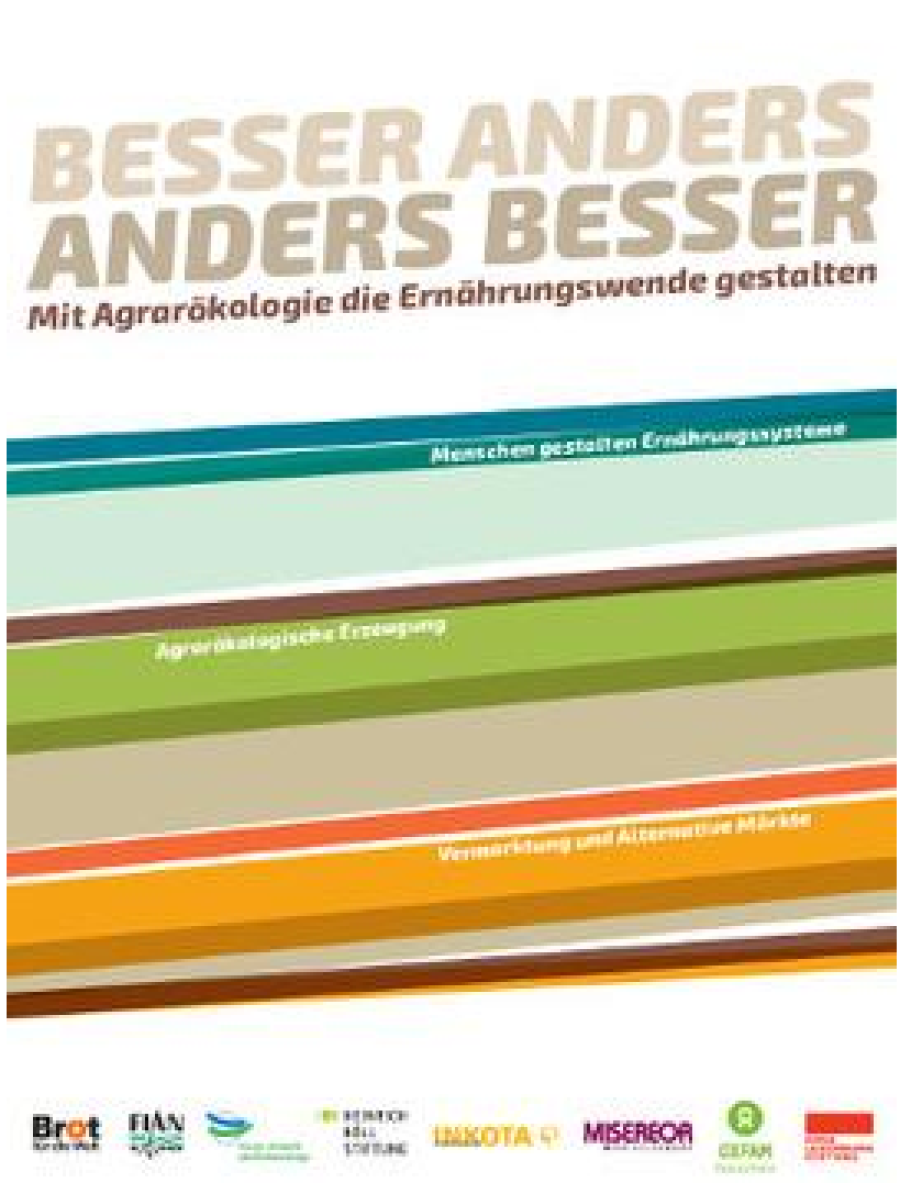
In der Broschüre „Besser Anders. Anders Besser“ zeigen Brot für die Welt, FIAN, das Forum Umwelt und Entwicklung, die Heinrich-Böll-Stiftung, das INKOTA-netzwerk, MISEREOR, Oxfam und die Rosa-Luxemburg-Stiftung, wie Agrarökologie erfolgreiche Alternativen zu industrieller und exportorientierter Landwirtschaft schafft.
Das Bündnis fordert die Bundesregierung auf, endlich agrarökologische Ansätze und alternative Vermarktungsformen stärker zu fördern und eine Ernährungswende voranzubringen. Statt um Profite für Agrarkonzerne müsse es ihr um die Unterstützung von Kleinbauern und Kleinbäuerinnen weltweit, den Schutz von Umwelt und Gesundheit sowie um gute Ernährung für alle gehen.

Zum Download der Broschüre „Besser anders, anders besser: Mit Agrarökologie die Ernährungswende gestalten“ geht es hier.

IWEAgrarökologie: Besser Anders. Anders Besser
Harald Lemke: Ethik des Essens

Harald Lemke: Ethik des Essens

Einführung in die Gastrosophie

Wie ernähren wir uns verantwortungsvoll? Ernährungsethik zählt zu den neuesten Entwicklungen der praktischen Philosophie. Angesichts der globalen Ernährungskrise stellt sie sich den unausweichlichen Fragen: Wie kann sich die Menschheit ernähren? Wie „gut“ sollten wir essen, so dass alle in den Genuss guten Essens kommen? Wie lässt sich eine Gastroethik begründen?
Weit mehr als von Kapitalismuskritik oder der Ausweitung der internationalen Protestbewegungen geht die Ernährungswende von unserem Denken aus – von einem gastrosophischen Umdenken. Harald Lemke macht deutlich: Es ist höchste Zeit, die dafür notwendigen Grundlagen zu schaffen und mit einer radikalen Selbstkritik der westlichen Philosophie des Essens zu beginnen. Die
Neuausgabe enthält ein ausführliches Vorwort zur Frage: „Was isst der Mensch?“

Über den Autor: Harald Lemke (Dr. phil. habil.), geb. 1965, ist Direktor des Internationalen Forums Gastrosophie und lehrt Philosophie am Zentrum für Gastrosophie der Universität Salzburg. Er ist Gastprofessor an der Slow Food Universität Pollenzo, am Department of Urban Management der Universität Kyoto sowie am Department of Philosophy der East China Normal University Shanghai und Fellow der Alexander von Humboldt-Stiftung, der Deutschen Bundesstiftung Umwelt sowie der Studienstiftung des Deutschen Volkes.

Mehr Informationen finden Sie auf der Website des Internationalen Forums Gastrosophie.

Das Buch „Ethik des Essens – Einführung in die Gastrosophie“ von Harald Lemke, Seiten: 592, Erscheinungsdatum 2. Auflage – überarbeitete Neuauflage: 05.2016 können Sie hier bestellen.

IWEHarald Lemke: Ethik des Essens
Deutsche Agrarkonzerne profitieren von Entwicklungshilfe

Deutsche Agrarkonzerne profitieren von Entwicklungshilfe

Studie von Oxfam Deutschland

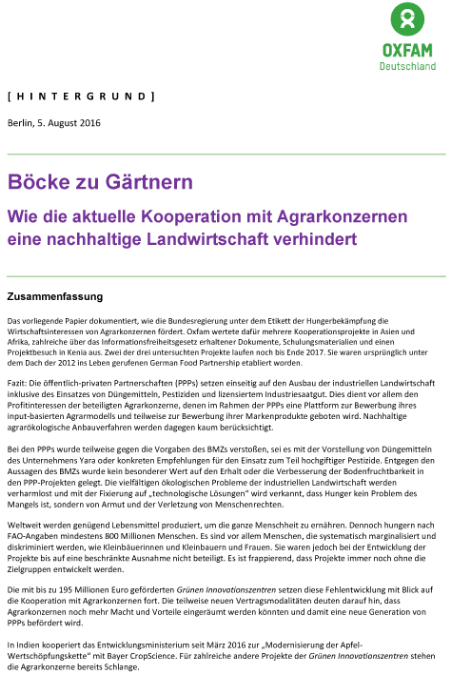
Die Bundesregierung begünstigt unter dem Deckmantel der Hungerbekämpfung einseitig die Agenda großer Agrarkonzerne, empfiehlt konkrete Markenprodukte und zum Teil hochgiftige Pestizide. Zu diesem Fazit kommt Oxfam Deutschland in dem Bericht „Böcke zu Gärtnern. Warum die aktuelle Kooperation mit Agrarkonzernen eine nachhaltige Landwirtschaft verhindert“.

Demnach verstößt das Entwicklungsministerium (BMZ) bei Kooperationsprojekten mit Agrarkonzernen gegen eigene Vorgaben, schließt agrarökologische Ansätze de facto aus und übergeht Kleinbauern bei der Projektentwicklung.
Die Oxfam-Studie zeigt, wie aktuelle Kooperationsprojekte mit Agrarkonzernen wie Bayer, BASF und Yara auf eine industrielle Landwirtschaft setzen. Von Hunger hauptsächlich betroffene Gruppen wie Kleinbauern oder Frauen wurden bei der Entwicklung der untersuchten Projekte bis auf eine beschränkte Ausnahme dagegen nicht beteiligt.

Oxfam wertete für den Bericht zahlreiche über das Informationsfreiheitsgesetz erhaltene Dokumente und Schulungsmaterialien zu drei öffentlich-privaten Partnerschaften (PPPs) aus: die Better Rice Initiative Asia (BRIA), die Competitive African Rice Initiative (CARI) sowie die Potato Initiative Africa (PIA).

Die vollständige Pressemitteilung von Oxfam Deutschland finden Sie hier.

Zur Studie „Böcke zu Gärtnern. Warum die aktuelle Kooperation mit Agrarkonzernen eine nachhaltige Landwirtschaft verhindert“ geht es hier.

IWEDeutsche Agrarkonzerne profitieren von Entwicklungshilfe
Bioökonomie: Neuer Raubbau oder Wirtschaftsform der Zukunft?

Bioökonomie: Neuer Raubbau oder Wirtschaftsform der Zukunft?

Buch "Global Gardening" von Christiane Grefe

Welches Potenzial hat Bioökonomie? Der Begriff weckt Assoziationen intelligenten Wirtschaftens im Einklang mit den Ressourcen der Erde. Zugleich schwingt in ihm die immer raffiniertere, nahezu vollständig profitorientierte Beherrschung von Pflanzen und Tieren, Böden und Gewässern bis in den letzten Winkel der Erde mit. Wer hat welche Interessen und Ziele im Sinn, wenn von Bioökonomie die Rede ist? Welche Werte, Zustände oder Errungenschaften gilt es im Blick zu halten?

Welche der so unterschiedlichen wie gegensätzlichen Konzepte der Bioökonomie zielen auf Nachhaltigkeit, Gerechtigkeit und Zukunftsfähigkeit? Welche können den globalen sozialen, ökonomischen und ökologischen Herausforderungen gerecht werden? Welche wären lediglich Raubbau im neuen Gewand? Wer wäre Nutznießer, wer Verlierer? Christiane Grefe lässt viele Akteure auf dem weiten Feld der Bioökonomie zu Wort kommen. Sie nähert sich differenziert und abwägend dem überaus komplexen Geflecht aus Anforderungen, Interessen, Möglichkeiten und Risiken des zukünftigen Wirtschaftens auf der Erde.

Das Buch „Global Gardening – Bioökonomie: Neuer Raubbau oder Wirtschaftsform der Zukunft?“ von Christiane Grefe, Seiten: 320, Erscheinungsdatum: 1.9.2016, Schriftenreihe der Bundeszentrale für politische Bildung (Bd. 1737) können Sie hier bestellen.

IWEBioökonomie: Neuer Raubbau oder Wirtschaftsform der Zukunft?
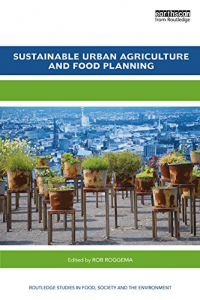
Sustainable Urban Agriculture and Food Planning

Sustainable Urban Agriculture and Food Planning

Published by Routledge

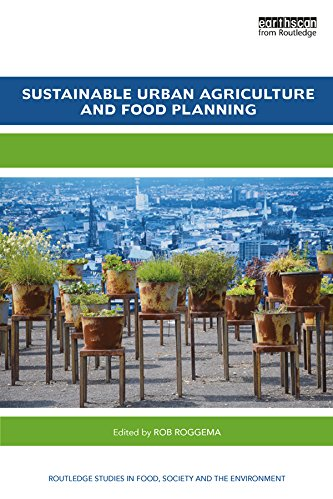
About the book: „As urban populations rise rapidly and concerns about food security increase, interest in urban agriculture has been renewed in both developed and developing countries. This book focuses on the sustainable development of urban agriculture and its relationship to food planning in cities.
It brings together the best revised and updated papers from the Sixth Association of European Schools of Planning (AESOP) conference on Sustainable Food Planning. The main emphasis is on the latest research and thinking on spatial planning and design, showing how urban agriculture provides opportunities to develop and enhance the spatial quality of urban environments.

Chapters address various topics such as a new theoretical model for understanding urban agriculture, how urban agriculture contributes to restoring our connections to nature, and the limitations of the garden city concept to food security. Case studies are included from several European countries, including Bulgaria, France, Germany, Italy, Netherlands, Romania, Spain, Turkey and the UK, as well as Australia, Canada, Cameroon, Ethiopia and the United States (New York and Los Angeles).

„Sustainable Urban Agriculture and Food Planning“, Edited by Rob Roggema, Routledge 2016, 272 pages. Available here.

IWESustainable Urban Agriculture and Food Planning
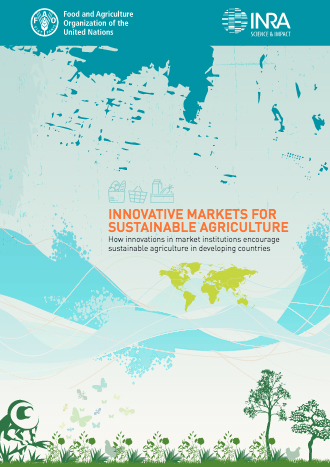
Innovative Markets for Sustainable Agriculture

Innovative Markets for Sustainable Agriculture

How Innovations in Market Institutions encourage Sustainable Agriculture in Developing Countries

Abstract: Between 2013 and 2015, the Food and Agriculture Organization of the United Nations (FAO) and the French National Institute for Agricultural Research (INRA) undertook a survey of innovative approaches that enable markets to act as incentives in the transition towards sustainable agriculture in developing countries. Through a competitive selection process, 15 cases from around the world provide insights into how small-scale initiatives that use sustainable production practices are supported by market demand, and create innovations in the institutions that govern sustainable practices and market exchanges.

These cases respond to both local and distant consumers’ concerns about the quality of the food that they eat. The book evidences that the initiatives rely upon social values (e.g. trustworthiness, health [nutrition and food safety], food sovereignty, promotion of youth and rural development, farmer and community livelihoods) to adapt sustainable practices to local contexts, while creating new market outlets for food products. Specifically, private sector and civil society actors are leading partnerships with the public sector to build market infrastructure, integrate sustainable agriculture into private and public education and extension programmes, and ensure the exchange of transparent information about market opportunities.

The results are: (i) system innovations that allow new rules for marketing and assuring the sustainable qualities of products; (ii) new forms of organization that permit actors to play multiple roles in the food system (e.g. farmer and auditor, farmer and researcher, consumer and auditor, consumer and intermediary); (iii) new forms of market exchange, such as box schemes, university kiosks, public procurement or systems of seed exchanges; and (iv) new technologies for sustainable agriculture (e.g. effective micro-organisms, biopesticides and soil analysis techniques). The public sector plays a key role in providing legitimate political and physical spaces for multiple actors to jointly create and share sustainable agricultural knowledge, practices and products.

Download PDF here.


IWEInnovative Markets for Sustainable Agriculture