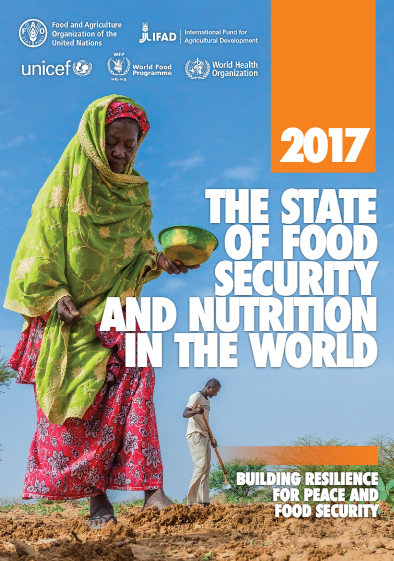
 A key worrisome finding of the annual FAO report „The State of Food Security and Nutrition in the World“ is that after a prolonged decline, the most recent estimates indicate that global
hunger increased in 2016 and now affects 815 million people.
Moreover, although still well below levels of a decade ago, the percentage of the global population estimated to be suffering from hunger also increased in 2016. In parts of the world, this recent surge in hunger reached an extreme level, with a famine declared in areas of South Sudan in early 2017 and alerts of high risk of famine issued for northeast Nigeria, Somalia and Yemen.
In 2016, the food security situation deteriorated sharply in parts of sub-Saharan Africa,
South-Eastern Asia and Western Asia. This was most notable in situations of conflict, in
particular where the food security impacts of conflict were compounded by droughts or floods, linked in part to the El Niño phenomenon. However, worsening food security conditions have also been observed in more peaceful settings, especially where economic slowdown has drained foreign exchange and fiscal revenues, affecting both food availability through reduced import capacity and food access through reduced fiscal space to protect poor households against rising domestic food prices.
The rising trend in undernourishment has not yet been reflected in rates of child stunting, which continue to fall. Nonetheless, the world is still home to 155 million stunted children. Levels of child stunting are still unacceptably high in some regions, and if current trends continue, the SDG target on reducing child stunting by 2030 will not be reached. Wasting also continues to threaten the lives of almost 52 million children (8 percent of children under five years of age), while childhood overweight and obesity rates are on the rise in most regions and in all regions for adults – all of which highlights the multiple burden of malnutrition as a cause for serious concern.
The failure to reduce world hunger is closely associated with the increase in conflict and violence in several parts of the world. Part 2 of this year’s report attempts to provide a clearer understanding of the nexus between conflict and food security and nutrition, and to demonstrate why efforts at fighting hunger must go hand-in-hand with those to sustain peace. Over the past decade, conflicts have risen dramatically in number and become more complex and intractable in nature. Some of the highest proportions of food-insecure and malnourished children are found in countries affected by conflict, a situation that is even more alarming in countries characterized by prolonged conflicts and fragile institutions.
This has set off alarm bells we cannot afford to ignore: we will not end hunger and all
forms of malnutrition by 2030 unless we address all the factors that undermine food
security and nutrition. Securing peaceful and inclusive societies is a necessary
condition to that end.
Download the FAO report „The State of Food Security and Nutrition in the World“ here.

 Klimawandel ist die Sache der anderen? Falsch: Er wird uns schneller erreichen, als uns lieb ist und er trifft uns in unserer Komfortzone. Bei Kaffee, beim Rotwein, auf der Grillplatte, beim Spargelessen, bei den Oliven. Er greift nach der süßen Seite unseres Lebens, nach Kakao und Schokolade. Selbst Austern und Miesmuscheln sind in Gefahr. Orangensaft adé. Mandeln verbrannt! Was tun?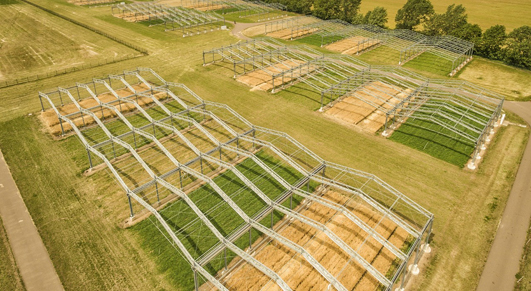
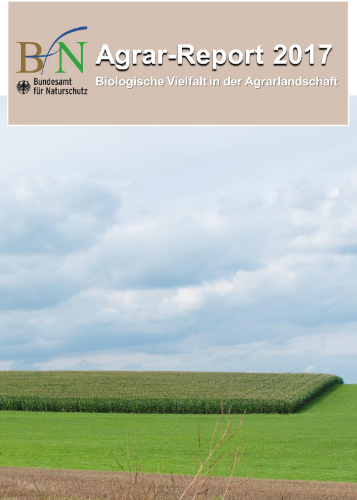
 Das Bundesamt für Naturschutz (BfN) hat erstmals einen umfassenden Agrar-Report zur biologischen Vielfalt vorgelegt. Das BfN zeigt in seiner Analyse, dass sich die Situation der biologischen Vielfalt in der Agrarlandschaft deutlich verschlechtert hat. „Diese Entwicklung muss für uns alle alarmierend sein“, erklärt BfN-Präsidentin Prof. Beate Jessel. „Wir brauchen deshalb dringend eine Kehrtwende in der Agrarpolitik.“
 Brot für die Welt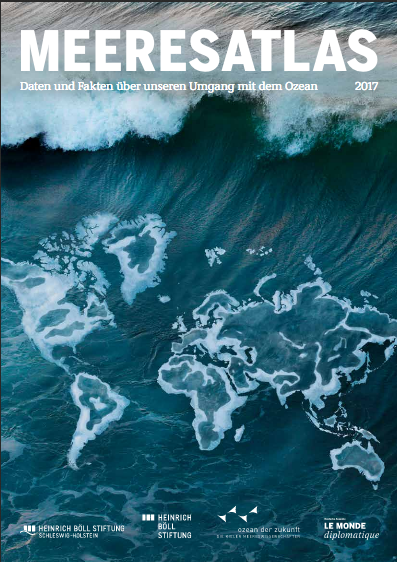
 Die Weltmeere stehen unter zunehmenden Druck und verändern sich rapide: Sie sind überfischt, verschmutzt und vermüllt, sie heizen sich auf und versauern, die Artenvielfalt nimmt ab – und zugleich verstärken sich die Auswirkungen dieser Prozesse gegenseitig. Das zeigt der „Meeresatlas 2017“, der auf 50 Seiten und in rund 80 Grafiken Daten, Fakten und Zusammenhänge über unseren Umgang mit dem Ozean präsentiert.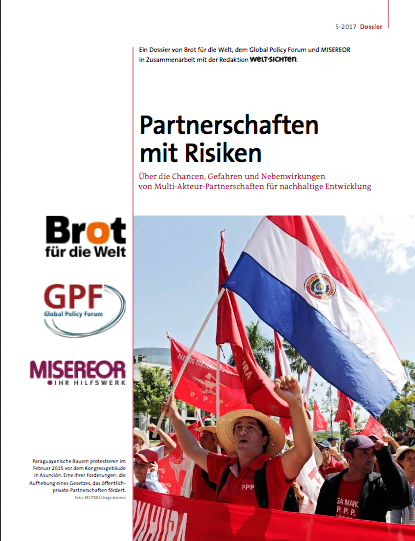
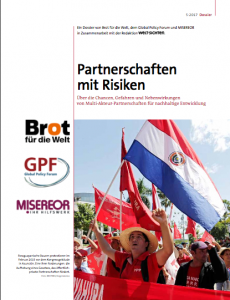 Das Dossier „Partnerschaften mit Risiken – Über die Chancen, Gefahren und Nebenwirkungen von Multi-Akteurpartnerschaften für nachhaltige Entwicklung“ nimmt verschiedene Formen des derzeit herrschenden Partnerschaftstrends kritisch unter die Lupe und thematisiert die Möglichkeiten und die Grenzen von Partnerschaften bei der Bewältigung globaler Herausforderungen. Die zentrale Frage lautet: Wie können Lösungen für die globalen Herausforderungen im Rahmen eines demokratischen Multilateralismus gefunden werden – und welche Rolle sollten Kooperationsmodelle öffentlicher und privater Akteure darin spielen?
 The publication „Soil Organic Carbon: The hidden potential“ by FAO provides an overview to decision-makers and practitioners of the main scientific facts and information regarding the current knowledge and knowledge gaps on Soil Organic Carbon.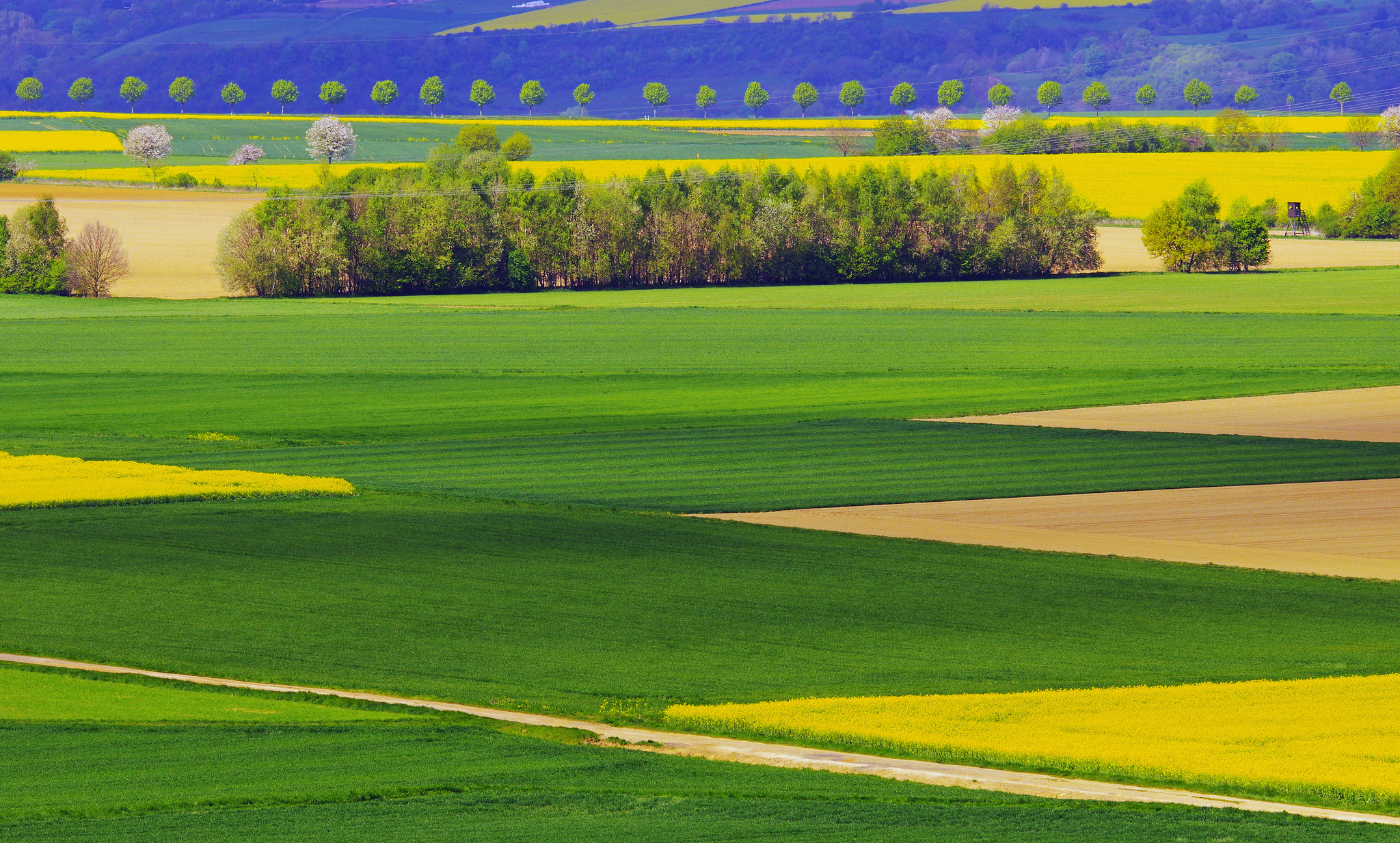
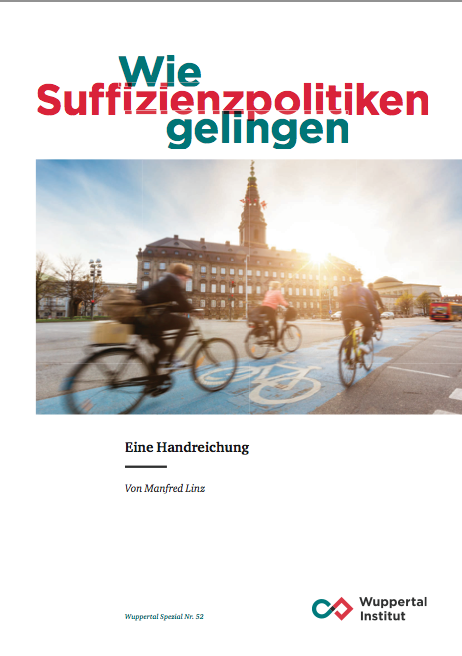
 In seiner Handreichung „Wie Suffizienzpolitiken gelingen“, die sich sowohl an politische EntscheiderInnen wie an aktive BürgerInnen richtet, geht er nun der Frage nach, auf welche Weise staatliche Maßnahmen dieser Art mit ihren Anreizen, aber eben auch mit ihren Grenzsetzungen und Verboten in der Wahlbevölkerung annehmbar werden können. Dafür untersucht Manfred Linz acht Politiken – unter anderem den Veggie Day der Grünen und die Lebensmittelampel-, um aus ihnen Merkmale für die Akzeptanz von Suffizienzpolitiken zu gewinnen.